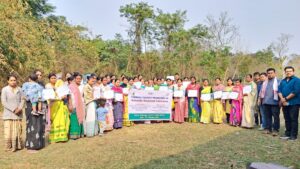
In the quiet, verdant lanes of Chamoguri, Titabar, a new narrative of self-reliance is being written—not with ink, but with the delicate, white blooms of oyster mushrooms. What began as a scientific initiative has blossomed into a movement of economic empowerment for the women of rural Assam.
The Vision: Science Meets the Soil
Rooted in the TSP Component of the AICRP on Mushroom Scheme, this project represents a powerful bridge between high-level research and grassroots reality. Funded by the ICAR – Directorate of Mushroom Research, Solan, and implemented by the expert faculty of the Department of Plant Pathology, Assam Agricultural University (AAU), Jorhat, the program found its local heartbeat through the mobilization efforts of Rakta Sanjeevani.
The goal was clear: Turn agricultural knowledge into a sustainable “Waste to Wealth” model for rural households.
A Step-by-Step Transformation
The success of this project lies in its meticulous, four-phase execution. Below is a descriptive look at how we moved from concept to cultivation.
Phase 1: The Training – Cultivating the Mind
The journey began under the canopy of the training center, where 50 women—carefully selected from a baseline survey of 60 households—gathered with a shared purpose. Here, the air was filled with the scent of steamed straw and the focus of eager learners. Experts from AAU Jorhat demystified the science of mycology, teaching the women that mushroom farming is an art of precision. They learned the “Goldilocks” balance of moisture, light, and hygiene required to turn simple agricultural waste into a high-protein superfood.
Phase 2: Spawn Distribution – Sowing the Seeds of Hope
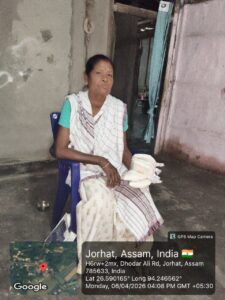
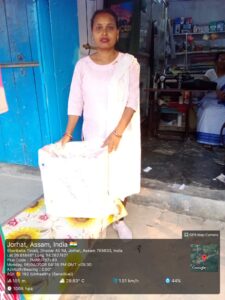
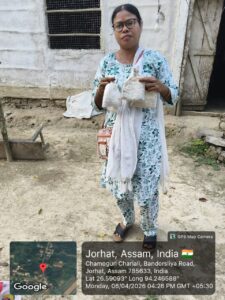
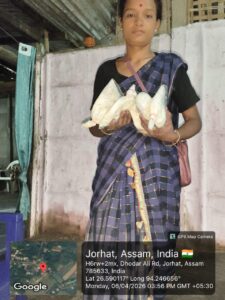

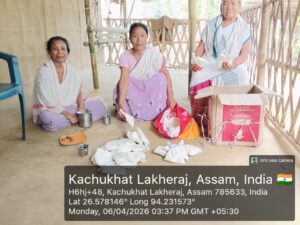
Knowledge is potential, but resources are the catalyst. In an atmosphere of excitement, high-quality mushroom spawn was distributed to the trainees. Each packet of spawn represented a promise—a starting point for a home-based business. For many of these women, holding these inputs was the moment the dream became a tangible reality. They left the center not just as students, but as equipped entrepreneurs.
Phase 3: The Farming – The Patience of Growth
Back in the courtyards and spare rooms of Chamoguri, the real work began. This phase was about the quiet dedication of daily maintenance. We watched as 30 women transformed small corners of their homes into sterile, productive cultivation units. They monitored temperatures, misted the beds with care, and waited for the first pinheads to emerge from the straw beds. It was a period of trial, error, and eventually, the triumph of seeing the first white clusters bloom.
Phase 4: Post-Harvest – Reaping the Rewards
The final phase is the most rewarding: the harvest. The sight of baskets overflowing with fresh, organic mushrooms marked the transition of 30 women into active “Agripeneurs.” But the work didn’t stop at picking; the women were guided in post-harvest handling to ensure their produce reached the market in peak condition. Today, these mushrooms are more than just a crop; they are a source of nutrition for families and a steady stream of independent income.
A Legacy of Empowerment
The impact of this project is measured beyond the 30 new units established. It is seen in the newfound confidence of the women of Chamoguri, who now see themselves as contributors to the local economy.
“We didn’t just teach them how to grow mushrooms,” says the project team. “We showed them that with the right skill and a little bit of space, they could grow their own futures.”
We extend our heartfelt gratitude to ICAR-DMR Solan and AAU Jorhat for providing the scientific backbone to this mission, and to the community of Titabar for embracing the spirit of innovation.